Offline sudoku for commuters: reclaim the subway, the tunnel and the long-haul flight
The best commute game is one that never needs a connection — and sudoku is the rare game where that's structurally possible. A sudoku puzzle is pure logic: nothing to stream, no server to phone home to, no content to download. Sudoku by Joseph generates every puzzle on the device itself, so it plays identically in a subway tunnel, in airplane mode over the Atlantic, or on a rural stretch with zero bars.
This page covers why so many "offline" games fail the tunnel test, what a sudoku commute routine looks like in practice, and how to set your phone up so the first dead zone never catches you out.
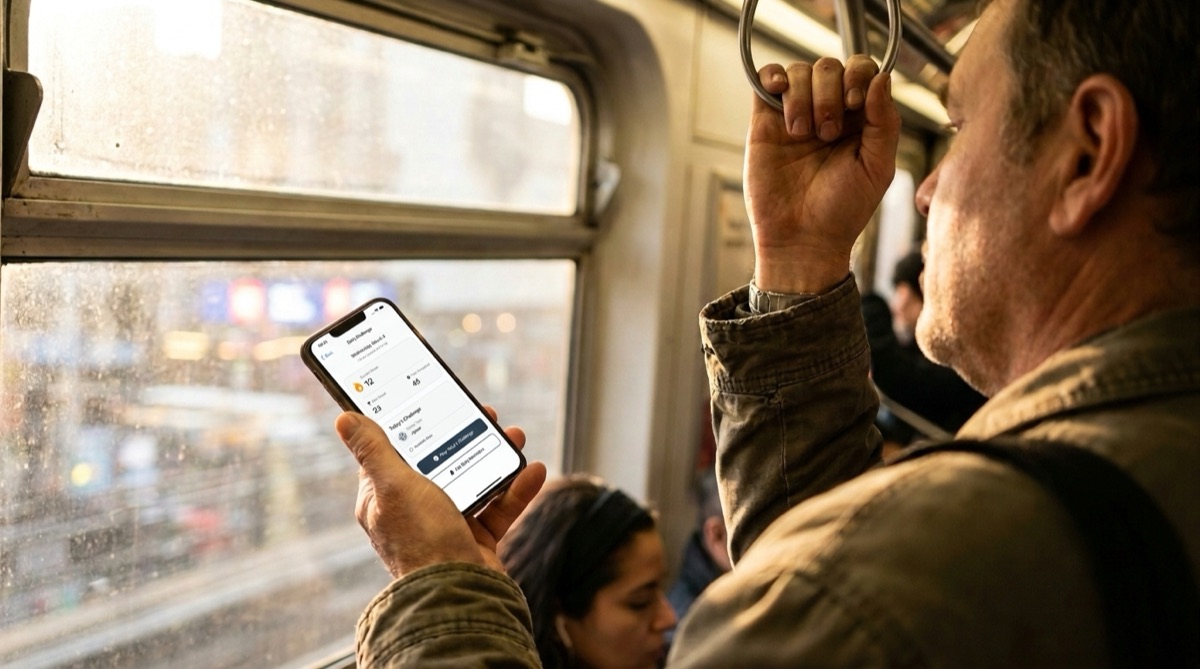
The problem: your commute is a dead zone, and most games secretly need the internet
Anyone who rides underground knows the pattern. You open a game as the doors close; it shows a spinner. The transit Wi-Fi teases one bar and delivers nothing. Your podcast didn't finish downloading. Thirty-five minutes of your day — twice, five days a week — quietly evaporates into staring at a "no connection" toast.
The frustrating part is how many games claim to be playable offline and then aren't, in practice:
- They phone home at launch — an ad call or license check that blocks the menu until it times out.
- They stall mid-session — the puzzle you're in works, but finishing it triggers a sync that hangs in the tunnel.
- Energy and lives systems meter you — five levels and you're told to wait or pay, fifteen minutes into a forty-minute ride. The mechanic is bad everywhere; on a commute it's absurd.
- Data caps punish the workaround — games that technically run offline but burn hundreds of megabytes on content and ads the moment they see signal.
Add flights — where airplane mode isn't a preference but the rule — and the requirement gets strict: a commute game must be fully self-contained. Then there's the interruption problem: commute play is chopped up by transfers, announcements and your actual stop, so the game must also let you drop it instantly and pick it up later without losing the thread.
Why sudoku fits the commute better than almost anything
Sudoku's shape happens to match the commute's shape almost exactly:
- It's self-contained by nature. A grid and your reasoning — no opponents to match with, no assets to stream. When puzzles are generated on-device, offline isn't a degraded mode; it's the same game.
- Sessions flex to the ride. An Easy Classic fits a ten-minute hop; a hard Killer fills a forty-minute ride; a Samurai swallows two hours of a long-haul flight. You choose the puzzle to fit the journey.
- It's interruption-proof. Sudoku state is entirely visible on the board — with pencil marks, your reasoning is literally written on the grid. Look up for your stop, come back tomorrow, and everything you knew is still there. No cutscene to rewatch, no run to restart.
- It's a better mental gear than the feed. Twenty minutes of focused deduction leaves you sharper at the office door than twenty minutes of scrolling — the commute starts feeling reclaimed rather than endured.
Why an app over the newspaper puzzle, the commuter classic? Supply and light, mostly: one puzzle per day at one fixed difficulty versus unlimited puzzles at yours, and a phone stays readable in a dim carriage with a free hand on the rail. The paper's spirit, minus its limits.
An illustrative example: the U-Bahn routine and the long-haul Samurai
Picture a commuter with a 35-minute U-Bahn ride each way — an illustration, not a testimonial. Say the routine settles into a rhythm: the Daily Challenge on the outbound leg, started as the train leaves the platform and usually done a few stations before the destination — the day's anchor, and the streak quietly climbs. Homebound, one Killer sudoku on Medium: cage arithmetic is absorbing enough to dissolve the ride, short enough to finish by the last stop. When a transfer cuts a puzzle short, it's simply there the next morning, pencil marks intact — pause, and pick up where you left off.
Underground the whole way, phone effectively offline for seventy minutes a day: nothing about the app behaves differently. No spinner at launch, no sync stall at the finish, and — because there are no energy caps or lives — a delayed train just means a second puzzle, not a paywall.
Then, say, a long-haul flight: eleven hours, airplane mode from pushback. One Samurai sudoku — five overlapping grids, a premium variant — is a genuine multi-hour project, the puzzle equivalent of a long novel. Somewhere over the ocean, the statistics screen tells the longer story: hundreds of puzzles solved, average Killer times drifting down month over month. That's the long arc a daily routine builds without trying.
The features that carry this story
Naming names, the parts of Sudoku by Joseph doing the work here:
- On-device puzzle generation — fully offline. Every puzzle in every variant is generated locally. Airplane mode, tunnels, dead zones: identical experience. Nothing to pre-download except the app itself.
- No energy, lives or daily caps — ever. A 40-minute commute means as many puzzles as you feel like. The app never meters you, and a wrong digit never locks the board.
- Pause and pick up where you left off. Leave a puzzle mid-solve — your entries and pencil marks are there when you come back, next station or next day.
- Daily Challenge with streaks. A new puzzle every day — a natural outbound-leg ritual, with a streak to protect. (Honest note: there\'s no archive of past days, so the day you skip is gone — which is precisely what makes the streak mean something.)
- Statistics. Solve counts and times per variant and difficulty turn five rides a week into a visible long arc.
- 12 variants sized to the journey. Classic and Killer for regular rides (both in the free tier, with Jigsaw), and the big formats — Samurai, 16x16 and the multi-grid family, in premium — for flights and rail trips. Premium also removes ads, which matters offline: the free tier is ad-supported when connected, though the puzzles themselves never need a connection. There\'s a 7-day trial; pricing varies by country — see the App Store.
How to set up sudoku for offline commuting
- Install at home, on Wi-Fi
Download Sudoku by Joseph for iPhone or Android before you travel — the install is the only step that needs a connection. If you're going premium for the big variants and no ads, start the trial while you're still online too.
- Open the app and each variant once
Launch the app and start a puzzle in each variant you plan to play, so you've confirmed everything you want is unlocked and working before you're underground or in the air.
- Flip on airplane mode and test it
Don't take offline claims on faith — ours included. Enable airplane mode at home and generate a fresh puzzle. It works, because generation happens on the device; now you know that before the tunnel does.
- Build the routine around the ride
Anchor the outbound leg with the Daily Challenge, then match puzzles to journey length — quick Classics for short hops, Killer for full rides, Samurai for flights. Pause freely at your stop; the board keeps your place.
Other options worth knowing
Sudoku isn't the only good way to reclaim a commute, so honest alternatives: downloaded podcasts and audiobooks are the obvious companion for standing-room rides where your hands aren't free — just download before you leave, since transit Wi-Fi won't save you. Offline chess against an engine is superb focused play; Lichess is free and its app works offline against the computer. Crossword apps from major newspapers let you download the day's puzzle ahead of time. An e-reader full of books needs no signal at all. Sudoku's particular edge is that it combines hands-on engagement, arbitrary session length, and true offline generation — no pre-downloading of content, ever — but the best commute is probably a rotation.
Frequently asked questions
Does Sudoku by Joseph really work in airplane mode?
Yes — fully. Puzzles are generated on the device, not fetched from a server, so every variant and difficulty works with no connection at all. You can verify it yourself in thirty seconds: enable airplane mode and start a new puzzle. The only things that need a connection are the initial install and ads in the free tier (which simply don't appear offline).
Will I hit a limit if I play many puzzles in one long ride?
No. There are no energy bars, lives, or daily caps anywhere in the app — that's a permanent design promise, not a premium perk. A delayed train or an eleven-hour flight just means more puzzles.
What happens to my puzzle when I have to jump off at my stop?
Leave it — your progress stays on the board. When you come back to the puzzle, your entries and pencil marks are where you left them, whether that's after the transfer or the next morning. Sudoku has no timer pressure unless you choose to care about the clock.
Can I play the Daily Challenge offline, and what about missed days?
The Daily Challenge is part of the app and offers a new puzzle every day. There is no archive of past days — a missed day is missed, which is what gives the streak its teeth. For unlimited offline play beyond the daily puzzle, every variant generates fresh puzzles on the device at any difficulty.
Make the tunnel the best part of the ride
12 variants, a Daily Challenge with streaks — and never any lives, coins or energy bars. The download is free.