How do you play Samurai Sudoku?
Samurai sudoku is five overlapping 9×9 sudoku grids solved as one puzzle. A center grid sits in the middle, and four more grids sit at its corners — each corner grid shares exactly one 3×3 box with the center. Every grid follows normal sudoku rules on its own (1–9 once per row, column and box), and the four shared boxes must satisfy both grids they belong to. That's the whole rulebook. The skill is in the solving order: the overlaps are the information channels, so you work them first and let the corners feed the center.
This guide walks through the layout, the one rule that makes it samurai, the strategy that follows from the geometry, and how it compares to a regular 9×9.
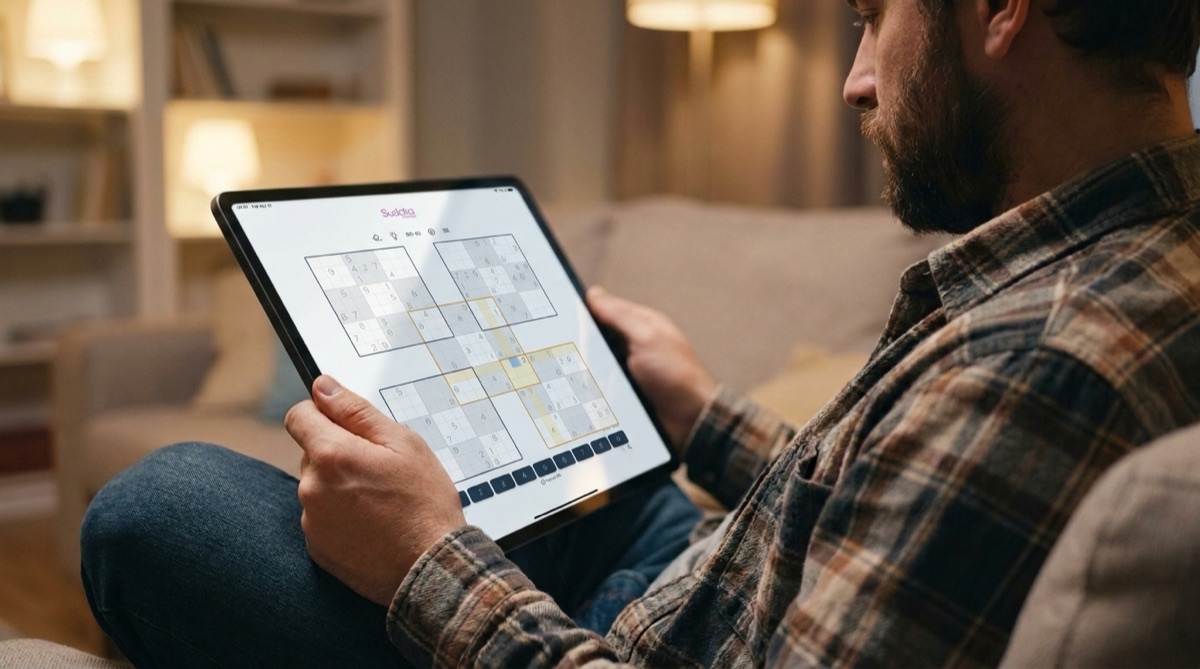
The five-grid layout
Picture a regular 9×9 grid in the center. Now place four more 9×9 grids so that each one overlaps a different corner of the center grid by exactly one 3×3 box: the top-left grid's bottom-right box is the center grid's top-left box, the top-right grid's bottom-left box is the center's top-right box, and so on for the two bottom grids. The result is the familiar X-shaped puzzle, 21×21 cells across at its widest.
Count the cells and the scale becomes clear: five grids of 81 cells would be 405, but the four shared boxes are counted twice, so a samurai has 405 − 36 = 369 cells — about four and a half regular sudokus' worth of solving in one sitting.
One thing the layout does not do: rows and columns never run across the whole 21×21 shape. A row belongs to one grid only. The top-left and top-right grids never constrain each other directly — everything they "say" to each other has to travel through the center grid via the shared boxes.
The one rule that makes it samurai
Each shared 3×3 box is a full citizen of two grids at once. A digit placed there must be legal in the corner grid's rows, columns and boxes and in the center grid's rows, columns and boxes. That double duty is the entire point of the format.
In practice it means every digit in a shared box radiates constraints in two directions. Place a 7 in the top-left shared box and you've eliminated 7 from three rows and three columns of the top-left grid and from three rows and three columns of the center grid. Nothing else in samurai is new — no extra digits, no new units, no diagonal rules. It's standard sudoku logic; there's just twice as much of it flowing through four small intersections.
That also means samurai puzzles can afford to be stingier with clues inside the center grid. Taken alone, the center often doesn't have a unique solution — it's the pressure arriving from the four corners that pins it down. If you try to solve the center in isolation, you'll stall; that's by design, not a flaw in the puzzle.
Solving order: work the overlaps, let the corners feed the center
Because the overlaps carry all the cross-grid information, the efficient route through a samurai is nearly always the same:
- Open with the corner grids. They usually carry more givens than the center and can be worked with ordinary technique. Prioritize deductions that land in or near the shared box — that's where progress compounds.
- Treat each shared box as a checkpoint. Every digit you resolve there immediately becomes a clue for the center grid. A corner grid that fills its shared box has done its most important job.
- Rotate instead of grinding. Don't try to finish one grid completely before moving on. When a corner stalls, move to the next one; when the center stalls, go back and push a corner further. Samurai rewards circulation — a single placement in one shared box often unsticks a grid you abandoned ten minutes ago.
- Expect the center to finish last. It starts with the least information and ends with the most. Late in the solve, the center typically collapses quickly once three or four shared boxes are done.
Techniques themselves don't change: scanning, hidden and naked singles, pairs, box-line reduction, and on hard puzzles X-Wings and chains — all applied per grid, exactly as in classic sudoku. The only genuinely new habit is checking both grids before committing a digit to a shared box.
Is samurai harder than regular sudoku — and how long does it take?
Bigger, not conceptually harder. If you can solve a medium 9×9, you already know every technique a medium samurai needs. What changes is endurance and bookkeeping: 369 cells, five grids to keep mentally separate, and a real cost to sloppy pencil marks — an error made in a shared box early on can quietly poison two grids before it surfaces.
Time-wise, plan for a session, not a coffee break. Since the puzzle holds roughly four and a half grids' worth of cells, a samurai broadly takes several times as long as a single puzzle at the same difficulty — and the cross-grid dependencies add some overhead on top. Many solvers treat one samurai as an evening puzzle and happily put it down and pick it back up. An app with saved progress makes that painless; on paper, guard the sheet.
Samurai, Gattai-5, and the overlapping family
If you dig into the enthusiast literature you'll meet the term gattai (Japanese for "merged"). Overlapping sudoku puzzles are classified as Gattai-N, where N is the number of merged grids — and samurai is simply Gattai-5 in its classic X arrangement. Down the scale, Gattai-2 (two overlapping grids, often called Twodoku) and Gattai-3 (three grids) offer the same cross-grid logic in shorter sittings. Other five-grid arrangements exist under their own names — Cross, Flower, Sohei, Windmill (Kazaguruma) — differing in how much the grids overlap and where. Same core skill, different geometry; our variants overview maps the whole family.
How to play Samurai Sudoku in Sudoku by Joseph
- Install the app
Download Sudoku by Joseph for iPhone, iPad or Android. The download is free and includes Classic, Jigsaw and Killer sudoku.
- Unlock premium
Samurai is one of the nine premium variants (alongside the rest of the multi-grid family and 16×16). Premium comes with a 7-day trial and also removes ads; pricing varies by country — see the App Store.
- Choose Samurai and a difficulty
Pick Samurai from the variant chooser and any difficulty from Easy to Diabolic. Nothing is gated behind a level map — every difficulty is open from the start.
- Solve overlaps-first, at your own pace
Work the corner grids into the shared boxes and rotate between grids as they stall. Pencil marks are unlimited, hints are on request, progress is saved, and there is no mistake counter — a samurai can span as many sessions as you like.
Practical samurai tips
- When you place a digit in a shared box, immediately scan its rows and columns in both grids — the second grid is where players forget to look.
- Stalled everywhere? Re-examine the four shared boxes specifically: a candidate eliminated by the center grid but still penciled in from the corner grid's perspective is the classic hidden unlock.
- Keep pencil marks disciplined from the first minute. On 369 cells, cleaning up sloppy candidates costs far more than writing them carefully did.
- Don't judge the center grid early. It is supposed to look underdetermined until the corners deliver — that's the format working as intended.
Other options worth knowing
Honest alternatives: Conceptis MultiSudoku is the established mobile home of overlapping sudoku, with samurai among its shapes — note that puzzles there are sold in per-pack bundles rather than one subscription. On paper, several newspapers run a weekend samurai, and free printable PDFs are easy to find around the web if you prefer pencil and eraser. Where Sudoku by Joseph differs is that Samurai sits alongside the whole overlapping family — Twodoku, Tripledoku, Gattai-3, Sohei, Cross, Flower and Windmill (Kazaguruma) — plus 16×16, in one app with unlimited puzzles per variant, saved progress, offline play, and no lives or coins anywhere.
Frequently asked questions
How many grids does Samurai Sudoku have, and do the overlaps count for both?
Five 9×9 grids: one center, four corners. Each corner grid shares exactly one 3×3 box with the center, and yes — every digit in a shared box must be valid in both grids simultaneously. That double constraint is the defining rule of the format.
Do rows and columns run across the entire 21x21 puzzle?
No. Rows and columns belong to individual 9×9 grids only — there are no 21-cell units. The four corner grids never constrain each other directly; information passes between them only through the center grid via the shared boxes.
Do I need new solving techniques for samurai sudoku?
No. Everything you use on a classic 9×9 — scanning, singles, pairs, box-line reduction, X-Wings on hard puzzles — applies unchanged within each grid. The only new habit is verifying a shared-box placement against both grids, and rotating between grids instead of finishing one at a time.
Is Samurai Sudoku free in Sudoku by Joseph?
Samurai is a premium variant. The free, ad-supported download includes Classic, Jigsaw and Killer; premium unlocks Samurai and the other multi-grid variants plus 16×16, and removes ads. There's a 7-day trial, and pricing varies by country — see the App Store.
Samurai Sudoku is included in premium
12 variants, a Daily Challenge with streaks — and never any lives, coins or energy bars. The download is free.